
How to write answers in Law?

How to write answers in law?
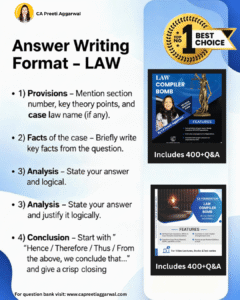
Use this 4-step format to make every Law answer examiner-friendly and marks-oriented.
1. Provisions first
⭐️ Start with the relevant Act and section, then write the core legal rule in 4-5 sentences.
⭐️ If a case law is applicable, mention only the correct name; avoid guessing section numbers or case names. You need not explain the case law unless the question is based entirely on the case law
2. Facts in short
⭐️ Pick 2–4 key facts from the question that actually affect the legal position instead of rewriting the whole story.
3. Analysis = Law + Facts
⭐️ Connect your provisions with the given facts and clearly state who is right, who is liable, what happens next etc.
⭐️ Use logical words like “Here, since… therefore…” and avoid emotional or personal opinions not supported by the Act.
4. Powerful conclusion
⭐️ In 1–3 lines, give a direct, exam-style conclusion starting with “Hence/Therefore/Thus/From the above, it is clear that…”.
⭐️ Do not introduce any new provision here; simply summarise the final outcome so the checker can award full marks quickly.
Students who consistently follow this P-F-A-C format (Provisions–Facts–Analysis–Conclusion) write sharper answers and often see an instant jump in their Law marks.
Save this post for your next mock test and share it with a friend who always writes long stories but still loses marks in Law.
Now let’s go through few questions and answer them in the above format
Q1) Moni and Tony were partners in the firm M/s MOTO & Company. They admitted Sony as partner in the firm and he is actively engaged in day-to-day activities of the firm. There is a tradition in the firm that all active partners will get a monthly remuneration of ₹ 20,000 but no express agreement was there. After admission of Sony in the firm, Moni and Tony were continuing getting salary from the firm but no salary was given to Sony from the firm. Sony claimed his remuneration but denied by existing partners by saying that there was no express agreement for that. Whether under the Indian Partnership Act, 1932, Sony can claim remuneration from the firm?
Provisions:
By virtue of provisions of Section 13(a) of the Indian Partnership Act, 1932 a partner is not entitled to receive remuneration for taking part in the conduct of the business. But this rule can always be varied by an express agreement, or by usage of trade, in which event the partner will be entitled to remuneration. Thus, a partner can claim remuneration even in the absence of a contract, when such remuneration is payable under the continued usage of the firm.
In other words, where it is customary to pay remuneration to a partner for conducting the business of the firm, he can claim it even in the absence of a contract for the payment of the same.
Facts of the case:
In the given problem, existing partners are getting regularly a monthly remuneration from firm customarily being working partners of the firm. The newly admitted partner claimed remuneration which was denied by the existing partners.
Analysis:
Where it is customary to pay remuneration to a partner for conducting the business of the firm, he can claim it even in the absence of a contract for the payment of the same.
As Sony also admitted as working partner of the firm, he is entitled to get remuneration like other partners.
Conclusion
Sony can claim remuneration from the firm.
Q2) Sohan is a trader in selling of wheat. Binod comes to his shop and ask Sohan to show him some good quality wheat. Binod is satisfied with the quality of wheat. Sohan agrees to sell 100 bags of wheat to Binod on 10th June 2021.
The delivery of wheat and the payment was to be made in next three months i.e. by 10th September 2021 by Binod. Before the goods are delivered to Binod, Sohan gets another customer Vikram in his shop who is ready to pay higher price for the wheat. Sohan sells the goods of Binod (which were already lying in his possession even after sale) to Vikram. Vikram has no knowledge that Sohan is not the owner of goods. With reference to Sale of Goods Act,1930, discuss if such a sale made by Sohan to Vikram is a valid sale?
Answer:
Provisions:
The given question deals with the rule related to transfer of title of goods. Section 27 of the Sale of Goods Act ,1930 specify the general rule ” No man can sell the goods and give a good title unless he is the owner of the goods”. The latin maxim ” NEMO DET QUOD NON HABET”. However, there are certain exceptions to this rule. One of the exceptions is given in Section 30 (1) of Sale of Goods Act,1930 wherein the sale by seller in possession of goods even after sale is made, is held to be valid. If the following conditions are satisfied, then it amounts to a valid sale although the seller is no more the owner of goods after sale.
(i) A seller has possession of goods after sale
(ii) with the consent of the other party (i.e. buyer)
(iii) the seller sells goods (already sold) to a new buyer
(iv) the new buyer acts in good faith
(v) The new buyer has no knowledge that the seller has no authority to sell.
Facts of the case:
In the given question, the seller Sohan has agreed to sell the goods to Binod, but delivery of the goods is still pending.
Analysis and conclusion:
Hence Sohan is in possession of the goods and this is with the consent of buyer i.e. Binod. Now Sohan sell those goods to Vikram, the new buyer. Vikram is buying the goods in good faith and also has no knowledge that Sohan is no longer the owner of goods.
Since all the above conditions given under Section 30 (1) of Sale of Goods Act, 1930 are satisfied, therefore the sale made by Sohan to Vikram is a valid sale even if Sohan is no longer the owner of goods.
Q3) Mr. P was running a shop selling good quality washing machines. Mr. Q came to his shop and asked for washing machine which is suitable for washing woollen clothes. Mr. P showed him a particular machine which Mr. Q liked and paid for it. Later on, when the machine was delivered at Mr. Q’s house, it was found that it was wrong machine and also unfit for washing woollen clothes.
He immediately informed Mr. P about the delivery of wrong machine. Mr. P refused to exchange the same, saying that the contract was complete after the delivery of washing machine and payment of price. With reference to the provisions of Sale of Goods Act, 1930, discuss whether Mr. P is right in refusing to exchange the washing machine?
Provisions:
According to Section 15 of the Sale of Goods Act, 1930, whenever the goods are sold as per sample as well as by description, the implied condition is that the goods must correspond to both sample as well as description. In case the goods do not correspond to sample or description, the buyer has the right to repudiate the contract.
Further under Sale of Goods Act, 1930 when the buyer makes known to the seller the particular purpose for which the goods are required and he relies on his judgment and skill of the seller, it is the duty of the seller to supply such goods which are fit for that purpose.
Facts of the case:
In the given case, Mr. Q has informed to Mr. P that he wanted the washing machine for washing woollen clothes. However, the machine which was delivered by Mr. P was unfit for the purpose for which Mr. Q wanted the machine.
Analysis and conclusion:
Based on the above provision and facts of case, we understand that there is breach of implied condition as to sample as well as description, therefore Mr. Q can either repudiate the contract or claim the refund of the price paid by him or he may require Mr. P to replace the washing machine with desired one.
Q4) Mr. Y issued a cheque for ₹10,000 to Mr. Z which was dishonoured by the Bank because Y did not have enough funds in his account and has no authority to overdraw. Examine as per the provisions of the Negotiable Instruments Act, 1881 whether-
(i) Mr. Y is liable for dishonour of cheque, if yes, what are the consequences for such an offence?
(ii) What would be your answer if Y issued a cheque as a donation to Mr. Z?
Provisions:
As per Section 138 of the Negotiable instruments Act, 1881,
Where any cheque drawn by a person on an account maintained by him with a banker—
- for payment of any amount of money
- to another person from that account
for the discharge, in whole or in part, of any debt or other liability, [A cheque given as gift or donation, or as a security or in discharge of a mere moral obligation, or for an illegal consideration, would be outside the purview of this section]
- is returned by the bank unpaid,
- either because of the—
- amount of money standing to the credit of that account is insufficient to honour the cheque, or
- that it exceeds the amount arranged to be paid from that account by an agreement made with that bank,
such person shall be deemed to have committed an offence and shall, be punished with imprisonment for a term which may extend to two years, or with fine which may extend to twice the amount of the cheque, or with both.
Facts of the case:
Mr. Y issued a cheque to Mr. Z which was dishonoured by the Bank due to insufficiency of funds.
Analysis and conclusion:
In the instant case,
(i) Since Y’s cheque was dishonoured by the Bank due to insufficiency of funds in his account, he shall be deemed to have committed an offence and shall, be punished with imprisonment for a term which may extend to two years, or with fine which may extend to ₹ 20,000, or with both.
(ii) A cheque given as gift or donation, or as a security or in discharge of a mere moral obligation, or for an illegal consideration, would be outside the purview of this section. Hence, if Y issued a cheque as a donation to Mr. Z, he shall not be liable under section 138 of the Act.
Q5) A, an assessee, had large income in the form of dividend and interest. In order to reduce his tax liability, he formed four private limited company and transferred his investments to them in exchange of their shares. The income earned by the companies was taken back by him as pretended loan. Can A be regarded as separate from the private limited company he formed?
Provisions:
The House of Lords in Salomon Vs Salomon & Co. Ltd. laid down that a company is a person distinct and separate from its members, and therefore, has an independent separate legal existence from its members who have constituted the company. However, under certain circumstances the separate entity of the company may be ignored by the courts. In such a case the courts ignore the corporate entity of the company and look behind the corporate façade and hold the persons in control of the management of its affairs liable for the acts of the company. Where a company is incorporated and formed by certain persons only for the purpose of evading taxes, the courts have discretion to disregard the corporate entity and tax the income in the hands of the appropriate assessee.
In Dinshaw Maneckjee Petit case it was held that the company was not a genuine company at all but merely the assessee himself disguised that the legal entity of a limited company. The assessee earned huge income by way of dividends and interest. So, he opened some companies and purchased their shares in exchange of his income by way of dividend and interest. This income was transferred back to assessee by way of loan. The court decided that the private companies were a sham and the corporate veil was lifted to decide the real owner of the income.
Facts of the case:
A, an assessee formed four private limited company and transferred his investments to them in exchange of their shares. The income earned by the companies was taken back by him as pretended loan.
Analysis:
In the instant case, the four private limited companies were formed by A, the assesse, purely and simply as a means of avoiding tax and the companies were nothing more than the façade of the assessee himself. Therefore, the whole idea of Mr. A was simply to split his income into four parts with a view to evade tax. No other business was done by the company.
Conclusion:
Hence, A cannot be regarded as separate from the private limited companies he formed.
To practice more Question and Answers refer my LAW Compiler (A detailed question bank containing all past exam questions, study material, MTP and RTP questions arranged unit-wise)
#castudents #cafoundation #cainter #caintermediate #law #icai #capreetiaggarwal